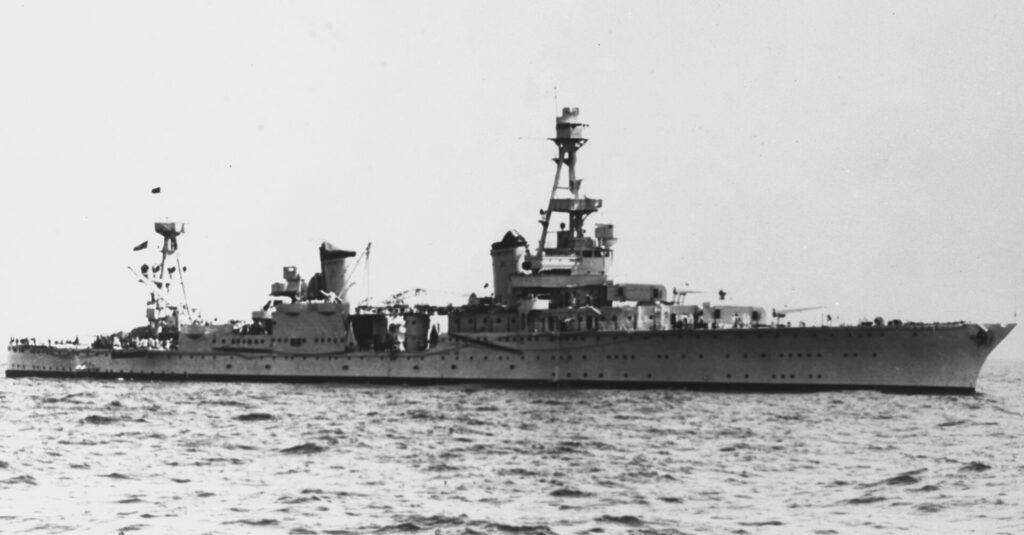
The Galloping Ghost of the Java Coast: The Night USS Houston Charged an Invasion Fleet — and Vanished for Three Years
On November 5th, 2026, US Navy divers went down to a ghost. Eighty feet below the Sunda Strait, they bolted a memorial plaque to the seabed. Beside it lies an American heavy cruiser, exactly where she fell in 1942, more than 650 of her men still around her. This is the ship Japan kept announcing sunk — and kept having to announce again. Tokyo Radio buried her so many times, her own crew laughed about it. They called her the Galloping Ghost of the Java Coast. Then, on one black night in 1942, the announcements finally came true.
A President’s Ship
Houston slid down the ways at Newport News, Virginia, on September 7th, 1929. Commissioned on June 17th, 1930, she was a Northampton-class heavy cruiser — six hundred feet, nine 8-inch guns, and speed to burn — named for the city of Houston, Texas.
Her most famous passenger came in July 1934: President Franklin D. Roosevelt, cruising to Hawaii. He sailed in her again in 1935, 1938, and 1939 — four presidential cruises, a record for any American warship. In November 1940 she became flagship of the Asiatic Fleet at Manila Bay. Her captain was Albert Rooks, who would earn the Medal of Honor at her side; her crew numbered about 1,100 men.
The Ship That Would Not Stay Sunk
The storm broke on December 7th, 1941: Pearl Harbor attacked, bombs on the Philippines within hours, and no help coming. The Asiatic Fleet fell back toward the Dutch East Indies, and Houston joined the ABDA fleet — American, British, Dutch, and Australian ships under Dutch Admiral Karel Doorman — fighting to hold the Malay Barrier. Japan ruled the sky, and many of Houston’s anti-aircraft shells proved defective.
On February 4th, in the Flores Sea, as many as thirty-seven Japanese bombers attacked the Allied ships. For two hours Captain Rooks threw his 10,000-ton cruiser around like a destroyer, and her gunners downed four attackers. Then a bomb exploded beside her after turret and touched off the powder inside: forty-eight men died and twenty were wounded; the after turret was dead for good. Houston limped into Tjilatjap to bury her dead, Tokyo Radio announced her sunk — and the Ghost simply reappeared, shooting.
On February 27th, Doorman’s fourteen ships met the invasion force in the Java Sea — the war’s largest surface battle so far, and a catastrophe. De Ruyter and Java went down with Doorman himself. Houston and the Australian cruiser Perth escaped to Tanjung Priok, Batavia’s port, magazines nearly empty. One door remained: the Sunda Strait.
One Black Night
On the night of February 28th, the cruisers sailed: Perth leading under Captain Hector Waller, Houston following, her after turret silent. Neither captain knew an invasion fleet waited ahead. Just after ten o’clock, more than fifty Japanese transports crowded Bantam Bay, landing the 16th Army, screened by the heavy cruisers Mogami and Mikuma, the light cruiser Natori, and nine destroyers.
At about twenty past eleven, the destroyer Fubuki sighted them; Waller turned toward the transports and opened fire. Charging through the anchorage, the cruisers set transports ablaze. Then Mogami fired six Long Lance torpedoes at Houston. All missed her, ran on into the anchorage, and sank five Japanese ships — including the transport carrying General Imamura, the invasion’s commander, blown into the sea by his own navy. For years, Japan let Houston take the blame.
Perth took four torpedoes in a few minutes and sank at twenty-five past midnight with 353 of her 681 men, Waller among them. Houston fought on alone, lit by searchlights, until her last rounds were star shells and practice shells. At half past midnight a shell burst on her bridge and killed Captain Rooks. A torpedo struck, then three more. Houston rolled over and sank, battle flags still flying. Of some 1,100 men, 368 lived to see the morning.
The Chaplain Who Would Not Save Himself
In the black water, wounded men clung to a wrecked airplane float. Among them was the chaplain, Commander George Rentz, fifty-nine years old. Again and again he tried to give his place on the float — then his life jacket — to younger, wounded men; again and again they refused. So Rentz prayed aloud with them, said he had lived most of his life, and quietly slipped away into the sea. His life jacket ended on one of the wounded. His body was never found. Rentz received the Navy Cross after his death — the only American Navy chaplain of the Second World War so honored. A frigate, USS Rentz, later carried his name.
Three Years of Silence
The ship had not just sunk; she had vanished — no distress call, no survivors’ report. The 368 survivors were gathered into Bicycle Camp in Batavia, where they met the Lost Battalion, Texas National Guardsmen captured on Java. Nine hundred and two Americans had simply disappeared, and at home the Navy could only report the ship missing.
In October 1942 the prisoners were packed into rusting freighters — hell ships — and carried through Singapore to Moulmein, Burma, to build a 250-mile railway through jungle and mountain, joining Thailand to Burma. Sixty-one thousand Allied prisoners worked on that line, beside more than 200,000 Asian laborers; by its completion in October 1943, more than 12,000 Allied prisoners and an estimated 90,000 Asian laborers were dead. Seventy-seven of Houston’s 368 survivors died in the camps.
On August 16th, 1945, three and a half years after the sinking, the word came: the war was over. Of the 368, only 291 remained. Only then did America learn how Houston had died.
A City Answers
The city of Houston had given the cruiser her name; now it gave her its sons. In May 1942 a recruiting drive called for 1,000 volunteers to replace the thousand believed lost. On Memorial Day, May 30th, 1942, before 150,000 people, an admiral swore them in beneath a sixty-foot model of the cruiser, and the Houston Volunteers left on five special trains for San Diego. Harris County raised more than 85 million dollars in war bonds — enough for a new cruiser named Houston, and a carrier besides. The light cruiser building as Vicksburg was renamed Houston in October 1942, commissioned in December 1943; torpedoed twice off Formosa in October 1944, she survived the war.
Still on Patrol
For decades the wreck lay in Banten Bay, in about 125 feet of water. The US Navy has banned recreational diving on her since 1973; she is a protected war grave, still United States property. In 2014 Navy divers confirmed her position — and found a crime scene, illegal salvagers stripping her hull plate by plate. Now America and Indonesia guard her together under a US-funded program running through 2028, local villagers as watchmen. In Houston, Texas, her bell stands on a granite monument above her crew’s names; every March, they gather for a Day of Remembrance.
The Galloping Ghost was reported sunk a dozen times. She is still on patrol, in the only way that matters now: in memory. And now, at last, her men have their plaque.
SHIP FILE
- Ship: USS Houston (CA-30), Northampton-class heavy cruiser
- Lost: 1 March 1942, Sunda Strait
- Crew: about 1,100 men
- Survived the sinking: 368
- Died in captivity: 77 of the 368
- Came home: 291
- Still with the ship: more than 650 sailors and Marines
Sources: This account rests on US Navy records and Naval History and Heritage Command materials, survivor testimony recorded after August 1945, and US Navy reporting on the wreck surveys and the November 2026 memorial dive.