

America’s Fastest Ocean Liner Was a Secret Troopship — Now They’ve Sunk It
On November 11th, 2026 — Veterans Day — work crews opened the sea valves of the SS United States, the fastest ocean liner ever built, twenty-two nautical miles off the coast of Florida. The SS United States was 990 feet long. The speed record the SS United States set in 1952 has never been beaten by another liner. It took hours longer than planned for the water to win. Then the SS United States rolled onto her side and slipped under the waves, and now the SS United States is a reef on the bottom of the Gulf.
Key Facts
- The SS United States is 990 feet long and was designed by William Francis Gibbs. Her keel was laid on 8 February 1950 at Newport News, Virginia.
- On trials on 10 June 1952 she reached 38.32 knots. On her maiden voyage, beginning 3 July 1952, she took the Blue Riband in 3 days, 10 hours and 40 minutes at 35.59 knots — still the fastest liner crossing.
- Hidden in her design was a military plan: the SS United States could be turned into a troopship able to carry more than 14,000 men without stopping for fuel. Her true top speed was a government secret for years.
- In seventeen years she made 800 crossings and carried more than a million passengers. Of a total cost of roughly $70 million, the government covered about $45 million for national-defense features.
- On Veterans Day, 11 November 2026, she was sunk as an artificial reef 22 nautical miles southwest of Destin, Florida, after Okaloosa County bought her in October 2024 for $1 million. She is now the largest artificial reef in the world.
Table of Contents
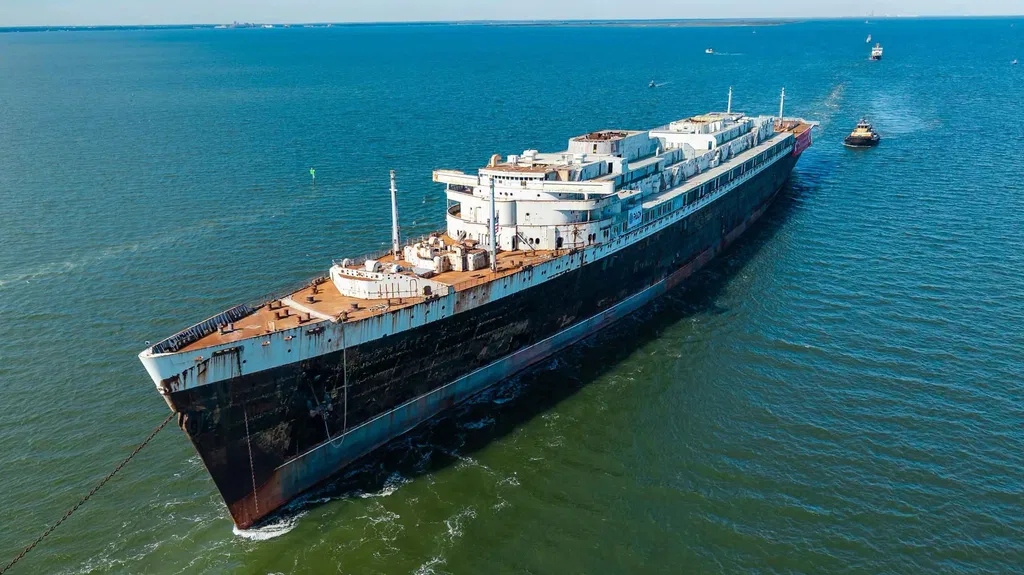
But this ship was never just about passengers. Hidden inside her design for the SS United States was a military plan. If war came, the SS United States could be stripped and turned into a troopship able to carry a whole army division — more than 14,000 men — across an ocean without stopping for fuel. For years, her true top speed was a government secret. So how does a ship like that end up as a home for fish?
Who Designed the SS United States?
To answer that, we go back to a boy watching a launch in 1894. His name was William Francis Gibbs. He was eight years old, standing in the crowd in Philadelphia as a great new liner slid into the water, and he decided right there that one day he would build a better one — not a little better, the best ship America had ever made. He spent the next fifty years getting ready. He left law behind and taught himself how ships were built.
After the First World War he rebuilt the largest liner in the world, the Leviathan — the former German Vaterland, taken by the United States as a prize of war — and turned her into the pride of the American merchant fleet.
Then came his first ship drawn from scratch, the Malolo, built for the run to Hawaii. On her sea trials in 1927, a freighter rammed her in the side and tore a huge hole near her engine room. Experts expected the SS United States to go down. The SS United States stayed afloat: Gibbs had split her hull into so many watertight compartments that the sea could not win. Gibbs was intense, demanding, and almost never satisfied. When the Second World War came, his firm, Gibbs & Cox, became a design factory — destroyers, cargo ships, the mass-produced Liberty ships. By one count, more than 70 percent of the American ships used in that war came out of his office.
But the SS United States he had dreamed about as a boy still did not exist.
A Liner on Paper, a Warship Underneath
During the war, the great liners went to work as troopships. Britain’s Queen Mary and Queen Elizabeth carried whole divisions across the Atlantic so fast that submarines could not catch them; Winston Churchill is often quoted as saying those two ships helped shorten the war by a year. America’s military planners noticed. In 1945, the United States Maritime Commission asked for a new kind of ship: in peacetime the SS United States would carry paying passengers; in wartime, soldiers. Gibbs already had the plan in his head — and his design won.
On paper the SS United States was a luxury liner. Underneath, she was built like a warship. Her engines were split between two separate engine rooms, so one torpedo could not stop her. The SS United States had backup systems for her backup systems, and her machinery was laid out like that of the largest aircraft carriers of the day. Her keel went down on February 8th, 1950, at Newport News, Virginia — in the same dry dock where the Navy had started a giant aircraft carrier also named United States, cancelled in 1949 just days after her keel was laid; the liner was the first ocean liner ever built in a dry dock.
Then the Korean War broke out, and with the liner only about a third finished, the government moved to take her over as a troop transport on the spot. Within about a month the decision was reversed: the SS United States would be finished as a liner after all, but with every military feature still built in. The taxpayers paid for that. Of a total cost of roughly $70 million, the government covered about $45 million, much of it for what were called national defense features.
Gibbs had one more obsession: fire. In 1934 the liner Morro Castle burned off New Jersey and more than 130 people died. In 1942 the great French liner Normandie burned and rolled over at her pier in New York while being converted into a troopship. Gibbs swore his ship would never burn, so he banned wood. Aboard SS United States there was almost no wood at all — the famous exception was the butcher’s block in the kitchen. Chairs, tables and lamps were metal, glass and fiberglass; even the curtains and carpets had to be fireproof.
There is a famous story about the ballroom piano: Gibbs wanted it made of aluminum, the makers wanted wood, so they poured gasoline over the mahogany and set it alight. The wood would not catch. Only then did Gibbs let the piano aboard. Her upper decks and her two huge funnels were aluminum — light, rust-free, and at the time the largest aluminum construction project in the world. The funnels became her signature: red, white and blue, teardrop-shaped, about 55 feet tall, the largest ever put on a ship. The SS United States was christened on June 23rd, 1951. Now she had to prove she was fast.
What Speed Record Does the SS United States Still Hold?
In June 1952 she went out on her sea trials. Her four steam turbines could put out about 240,000 horsepower, and on June 10th, on a full-power run, she reached 38.32 knots — more than 44 miles an hour. For a ship nearly 1,000 feet long that was astonishing, and nobody outside a small circle was allowed to know. On July 3rd, 1952, she left New York on her maiden voyage. The prize was the Blue Riband, the unofficial title for the fastest Atlantic crossing, held for fourteen years by Britain’s Queen Mary.
Behind the scenes the men in charge were nervous — the memory of Titanic was personal: company director Vincent Astor had lost his father on that ship, and company president John Franklin was the son of the man who ran White Star Line’s New York office the night Titanic went down. Franklin wrote a sealed statement to be released only if something went wrong.
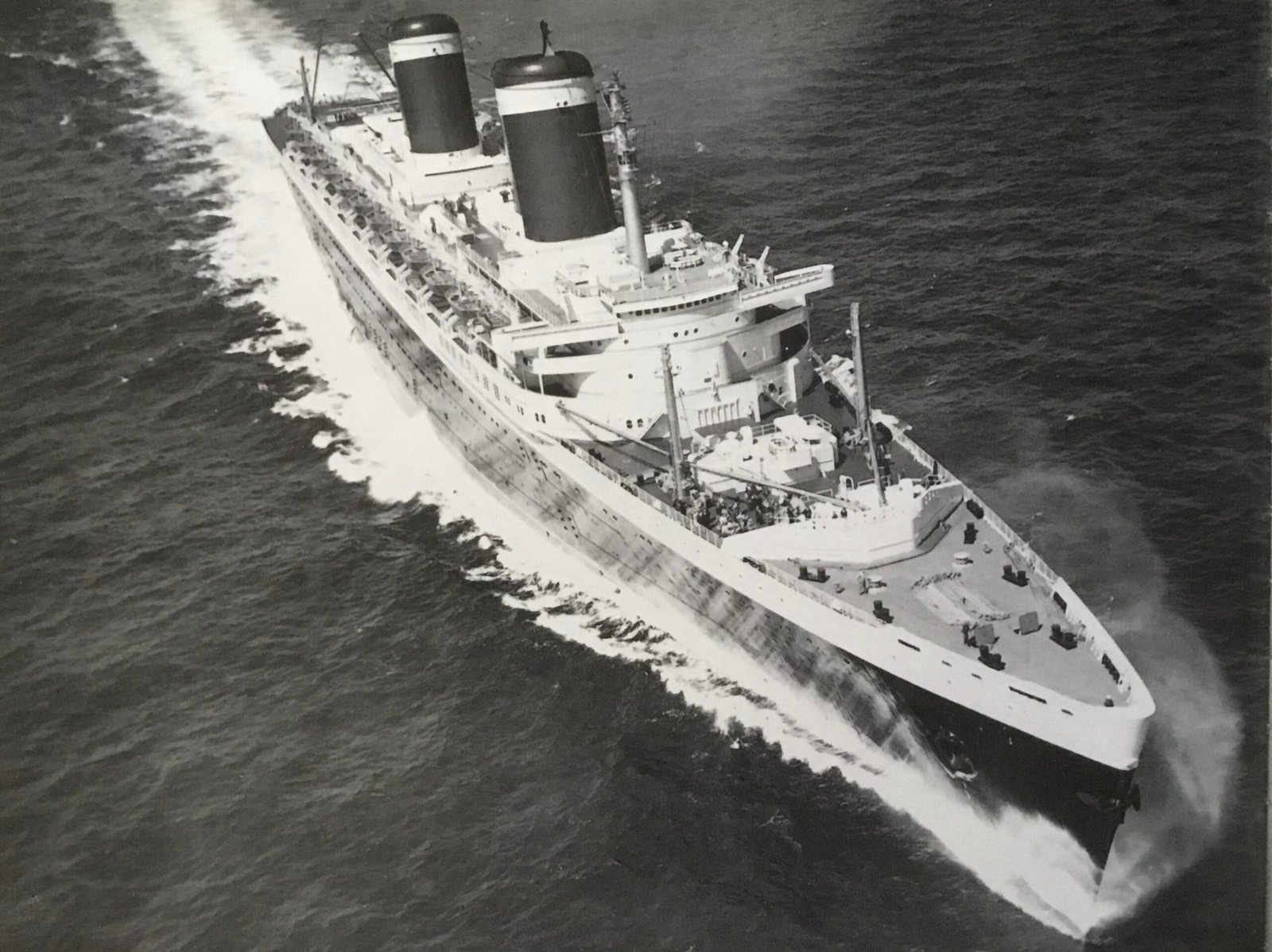
Nothing went wrong. The SS United States crossed from the Ambrose lightship outside New York to Bishop Rock off the tip of England in 3 days, 10 hours and 40 minutes, averaging 35.59 knots, and beat the Queen Mary’s record by more than ten hours. Then she turned around and broke the westbound record too, at 34.51 knots. Fresh paint on her bow had been worn away by the speed. New York went wild; her captain, Commodore Harry Manning, was given a ticker-tape parade before some 150,000 people. It was the first time in a hundred years that an American ship had held the Blue Riband.
Here is the strange part: Gibbs did not want her to win by too much. He told the crew to beat the record by a reasonable amount — if a rival ever built a faster ship, he wanted something held back. Her real top speed stayed classified military information for years; rumors claimed 43 knots, and in 1968 the New York Times reported she could make 42. The true number came out only after the Navy lifted the secrecy: 38.32 knots on trials. Still amazing — just not a legend. To this day, no other ocean liner has crossed the Atlantic faster.
The Queen of the Atlantic — and the Jets
For the next few years she was the most popular ship on the North Atlantic, cruising at about 30 knots, fast enough to cross in under five days. Her passenger lists read like a who’s who: Marilyn Monroe, Judy Garland, Cary Grant, Salvador Dalí, Duke Ellington, Walt Disney — who put the ship in his 1962 movie Bon Voyage! The Duke and Duchess of Windsor made one suite famous, the “Duck Suite,” named for the paintings of ducks on its walls. A young Bill Clinton sailed on her in 1968.
But she was not only for the rich: she carried almost 2,000 passengers with about a thousand crew, and down in tourist class the cheapest tickets were often bought by students and immigrants heading to a new life. For more than a million people, this ship was the bridge between two worlds. A first-class ticket started at about $350 — around $4,000 in today’s money.
Then the sky changed everything. In 1957, for the first time, more people crossed the Atlantic by plane than by ship; the next year, jets began flying the route. A crossing that took the fastest ship in the world four or five days now took seven or eight hours. Through the 1960s, crew strikes cancelled voyage after voyage, and in 1961 the government stopped sending military personnel aboard her, saying liners would be sitting ducks for Soviet bombers. By the late 1960s she was losing millions of dollars a year.
In the fall of 1969 she came home from her 400th round trip and entered the shipyard for her yearly overhaul — and in November the company announced she would never sail again. The crew had almost no warning. In seventeen years she had made 800 crossings and carried more than a million passengers. When work stopped, her furniture, her fittings, even crew uniforms were left right where they were; painters had been halfway through her funnels. To this day, you can see where they stopped.
Why Did the SS United States Sit Idle for Decades?
At first the government kept her: the Navy sealed her up and parked her in Norfolk, Virginia, and her military secrets were only officially lifted in 1977. Then came a long line of owners with big dreams and not enough money. A Seattle developer wanted floating condominiums; that failed. In 1984, to pay the bills, everything inside her was sold at auction — some 3,000 bidders carried away her furniture, artwork and fittings. In 1992 a Turkish company bought her and towed her across the Atlantic; her walls were full of asbestos, the very fireproofing that had made her so safe, and to remove it she was towed to Sevastopol, Ukraine, where workers stripped her to bare steel.
When the money ran out she was towed back across the Atlantic to America, arriving in Philadelphia in 1996. The SS United States would stay there for almost thirty years.
Norwegian Cruise Line bought her in 2003 and talked about bringing her back to life; it never happened. By 2009 she was close to being sold for scrap when a group of fans — including Gibbs’s own granddaughter, Susan Gibbs — formed the SS United States Conservancy and, with help from a Philadelphia philanthropist, bought the SS United States in 2011. For the next decade, plan after plan came and went: a museum, a hotel, a cruise ship again, offices; in 2023, developers unveiled a plan for a 1,000-room hotel on the Hudson River in New York. The ship just sat there, rusting, her paint peeling off in sheets.
There was one more military plan in her story: in 1983, while she sat rotting, the Pentagon studied turning her into a giant hospital ship — USNS United States, with about 1,600 hospital beds, up to 23 operating rooms and a helicopter deck. Her speed meant she could reach a crisis almost anywhere in the world, fast. The Navy decided it was too expensive, and the plan never left the paper. It was the last time anyone imagined her going to war.
Then the landlord ran out of patience. In 2021 the company that owned her pier doubled the rent to $1,700 a day; the Conservancy refused to pay, and both sides went to court. In June 2024 a federal judge ruled the SS United States had to leave the pier within ninety days — but nobody had anywhere to put her. That summer an unusual offer came from Florida: Okaloosa County, home to Destin and Fort Walton Beach, offered to buy the SS United States and sink her on purpose, as an artificial reef for divers and fish. In October 2024 the deal was done — the price was $1 million, and the whole project was expected to cost around $10 million.
Veterans Day
On February 19th, 2025, tugboats pulled her away from Philadelphia for the last time. Crowds lined the waterfront, and traffic was stopped on bridges as she passed underneath. Two weeks later she reached Mobile, Alabama, where workers spent more than a year cleaning her out — fuel, wiring, paint, anything that could harm sea life — and cutting holes so water and fish could move through her and she would settle upright on the bottom. In August 2025 cranes lifted off both her famous funnels and her mast; they are being saved for a museum on land.
Not everything went down with her: her four giant propellers were saved years ago — one stands at Pier 76 in New York, another at the Merchant Marine Academy in Kings Point, a third at SUNY Maritime College, and the fourth at the Mariners’ Museum in Virginia, still mounted on its original drive shaft. Her bell hangs in a clock tower at Christopher Newport University, where new students ring it when they arrive and again when they graduate.
On November 9th, 2026, she left Mobile under tow for the last time. Officials moved the sinking up a day, to Wednesday, November 11th, because strong winds were forecast; the public send-off ceremony was cancelled. Days earlier, a preservation group had gone to federal court to stop the sinking, citing toxic paint and historic-preservation law; on November 7 a judge dismissed the case, and the tow went ahead. It was Veterans Day — for a ship that was built to carry soldiers. The site lies twenty-two nautical miles southwest of Destin, about twelve miles from another famous wreck, the aircraft carrier USS Oriskany, sunk as a reef in 2006.
Hundreds of boats gathered offshore to watch, and back in Destin people followed a live feed on a big outdoor screen. The plan used no explosives: crews removed plugs in her hull and let the water in. It went far slower than planned: water first began going in early in the afternoon, the main valves were opened around 4 p.m., and the old liner fought the sea for roughly seven hours in all.
For hours that cloudy afternoon, much of the ship was still above the water; a county spokesman said, “She was designed to be unsinkable, and that fact has definitely given our crew some challenges today.” Finally, around 9:00 p.m. local (Central) time, she rolled hard to port and went under stern-first. Sonar and an underwater robot later showed she had settled upright on the bottom, almost exactly where the county had aimed.
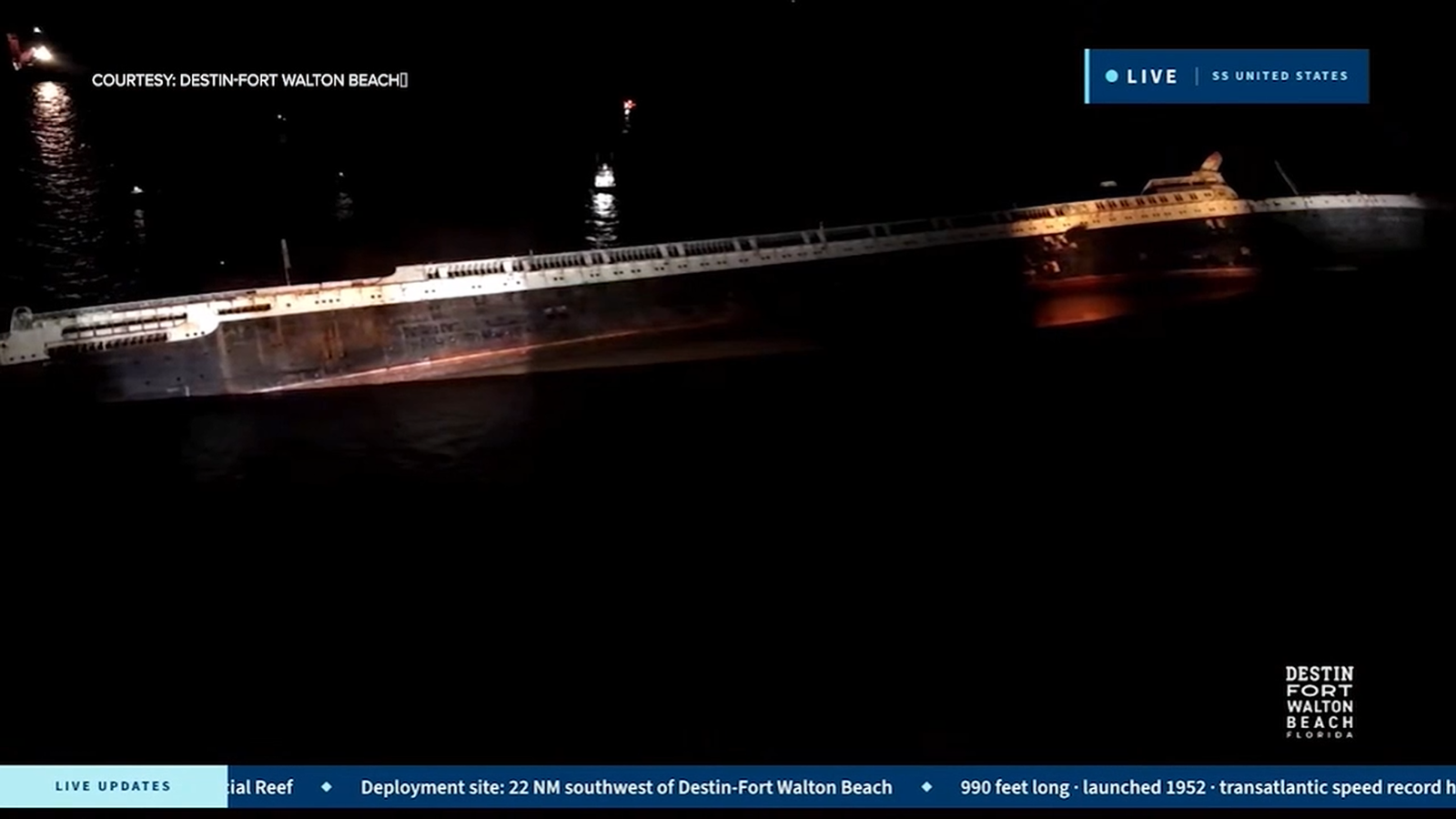
The water there is about 180 feet deep; her uppermost deck rests about 60 feet below the surface, according to Okaloosa County — within reach of recreational divers, while the deeper parts of the wreck are for technical divers. She is now the largest artificial reef in the world. Scientists from the Woods Hole Oceanographic Institution marked about 132 spots on the ship so they can return every year and watch life take over. Within a few years her steel should be covered in sea life, and divers will swim along a deck where Marilyn Monroe once walked.
Some people call this a happy ending: the ship gets to live on, and she will bring divers and money to the Florida coast for generations. Others call it a national failure: America built the fastest liner in history, hid a warship inside her, and then could not find a way to keep her afloat. So which is it? Should America have saved the SS United States — or is a reef the best ending she could get?
SHIP FILE
- Ship: SS United States (1952), ocean liner designed by William Francis Gibbs
- Length: 990 feet
- Trial speed (classified for years): 38.32 knots
- Blue Riband: Eastbound 3 days, 10 hours, 40 minutes at 35.59 knots (July 1952) — still the fastest liner crossing ever
- Secret role: Convertible to a troopship for about 14,400 soldiers
- Career: 800 crossings, more than 1 million passengers, 1952–1969
- Final resting place: 22 nautical miles southwest of Destin, Florida — the world’s largest artificial reef (sunk 11 November 2026)
Why was the SS United States sunk in 2026?
Okaloosa County, Florida, bought the SS United States in October 2024 for $1 million, planning to sink her as an artificial reef for divers and fish. On Veterans Day, 11 November 2026, crews opened her sea valves 22 nautical miles southwest of Destin. She is now the largest artificial reef in the world.
What speed record does the SS United States still hold?
On her maiden voyage in July 1952, the SS United States crossed from the Ambrose lightship outside New York to Bishop Rock in 3 days, 10 hours and 40 minutes, averaging 35.59 knots, and beat the Queen Mary’s record by more than ten hours. No later liner has beaten that eastbound time.
Who designed the SS United States?
William Francis Gibbs designed the SS United States. As a boy in 1894 he watched a liner launch in Philadelphia and decided to build a better one. His firm, Gibbs & Cox, later designed much of the American fleet in the Second World War; this liner was the ship he had planned for decades.
Was the SS United States really built as a secret troopship?
Yes. A 1945 federal brief asked for a liner that could become a troopship in wartime. The SS United States could carry a whole army division — more than 14,000 men — across an ocean without refueling. Her engines were split between two rooms, and her true top speed stayed classified for years.
How deep is the wreck of the SS United States?
The reef site lies in about 180 feet of water, 22 nautical miles southwest of Destin and about 12 miles from the wreck of USS Oriskany. According to Okaloosa County, her uppermost deck rests about 60 feet below the surface, within reach of recreational divers, while the deeper decks lie farther down.
Sources and further reading
- SS United States — Wikipedia (overview with full citations)
- Okaloosa County — news release on the successful deployment (12 Nov 2026, PDF)
- WEAR-TV — SS United States sank after valve delay, landed upright (12 Nov 2026)
- Woods Hole Oceanographic Institution — studying the world’s largest artificial reef (11 Nov 2026)
- SS United States Conservancy
More from History Not Taught
- The Galloping Ghost of the Java Coast: USS Houston
- Capsized in 22 Minutes — The Miracle on the Mississippi
- The American Civil War: How America Tore Itself Apart
